
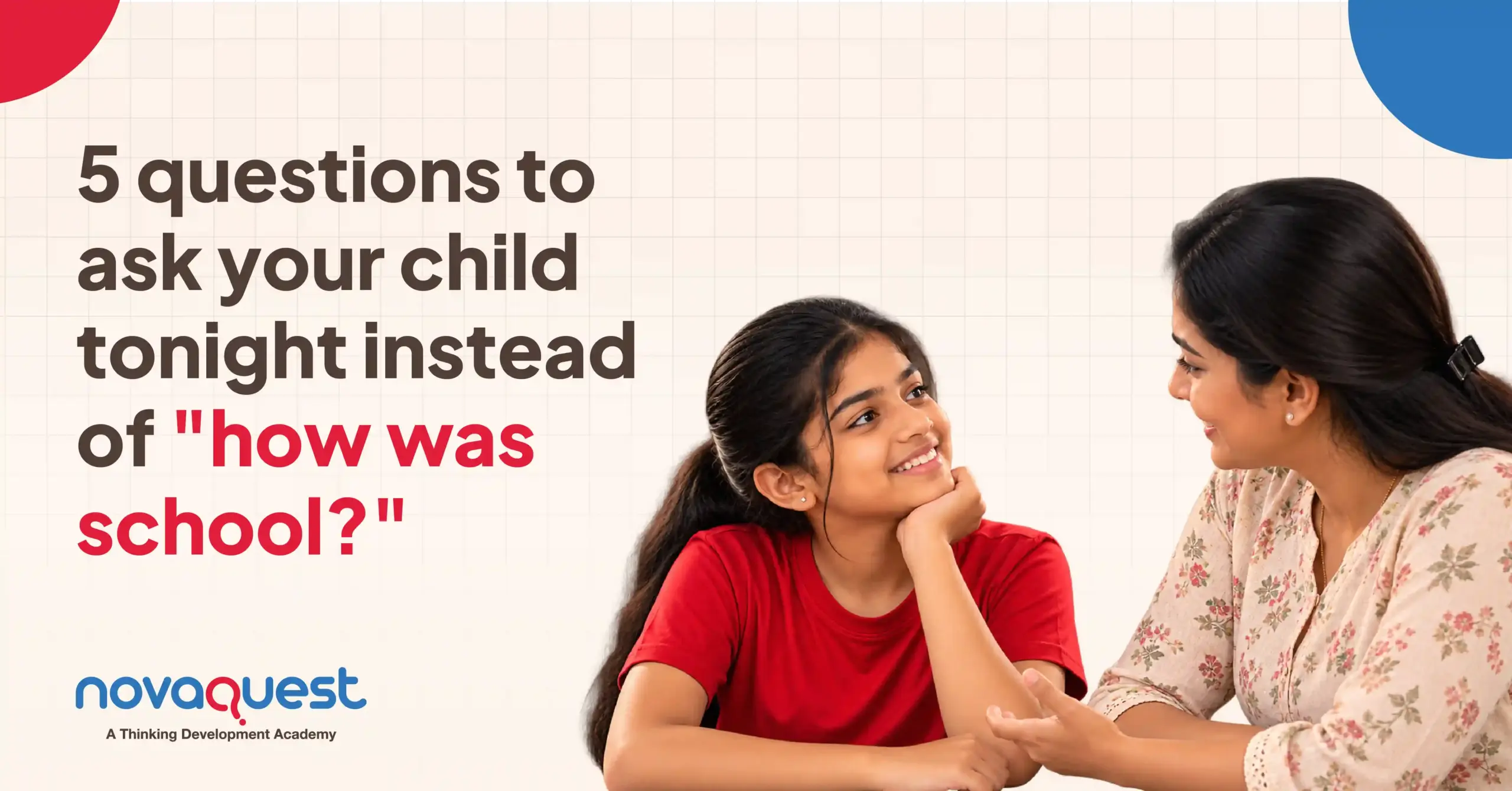
Every evening, in almost every home, the same question gets asked. “How was school?” And in almost every home, the same one-word answer comes back. “Fine.”
Parents often assume the child is being short with them. Actually, something else is happening. Most children go through their whole day in what we can call answer mode. They’re constantly being asked to recall, repeat, and respond correctly. So when they get home, they answer you the exact same way they answered their teacher all day, quickly, and without much thought behind it.
There’s a second mode most children rarely get to use. We can call it thinking mode. This is where a child actually pauses, works something out, and explains it in their own words. It looks completely different from answer mode, and most children only enter it a handful of times a week, if that.
Here’s the simplest way to tell the two apart.
| A | Answer Mode | Thinking Mode |
|---|---|---|
| What it looks like | Repeats what was taught, word for word | Explains it their own way |
| When stuck | Waits for the answer | Tries a few things first |
| When wrong | Feels bad, wants to move on | Wants to know why, tries again |
| At home | Says “fine,” “nothing,” “okay” | Tells you a real moment or story |
First, a quick check on your own child
Before the five questions, answer these three honestly. They’ll tell you which mode your child spends most of their time in.
1. When your child gets a question wrong, what usually happens?
🔵 They feel upset and want to move past it quickly
🔴 They want to know why it was wrong, and try again
2. Can your child explain a topic they scored well in, without looking at the book?
🔵 They repeat it almost exactly like the textbook
🔴 They explain it in their own words, and it makes sense
3. When they’re stuck on something new, what do they do first?
🔵 Wait for you or someone else to explain
🔴 Try a few things on their own before asking
Mostly 🔵: Your child is likely spending most of their day in answer mode. This isn’t a sign of anything wrong, it just means they haven’t had many chances to practise the other mode yet.
Mostly 🔴: Your child already steps into thinking mode on their own sometimes. The gap now is making sure that instinct gets used more often, not less.
Either way, the good news is the same. Thinking mode is a habit, and like any habit, it can be built with the right questions.
Let’s get to the five questions
1. “What’s something that made you think hard today?”
This skips past “what did you learn” and goes straight to a real moment of effort. You’ll hear about a tricky problem, a confusing instruction, or even something that came up with friends.
2. “Did anything not make sense today?”
This gives your child permission to admit confusion, instead of quietly burying it and moving to the next class. Most children never say this unless asked directly.
3. “What’s one thing you disagreed with today?”
Children are rarely asked what they disagree with, only what they got right. This tells you how they’re forming their own opinions, and whether they feel safe sharing them with you.
4. “If you could teach me one thing from today, what would it be?”
Flip the roles. If your child can explain something clearly, they understood it. If they struggle, they were likely repeating it back without really knowing why.
5. “What’s something you want to try again tomorrow?”
This checks whether your child can admit something didn’t go well, and still wants another go at it. That willingness to retry matters more than getting it right the first time.
How this connects to something bigger
Asking better questions at home is a great start. But one conversation a day can only do so much. Real thinking mode gets built through repeated practice, the same way a muscle gets built through repeated use, not through one good workout.
This is exactly what NovaQuest is built around. Every session follows the same simple flow.
What happens inside NovaQuest
Observe
↓
Ask Questions
↓
Build
↓
Experiment
↓
Fail Safely (without guilt, without judgment)
↓
Observe Again
↓
Improve
↓
Explain
Every NovaQuest activity follows this same cycle. Children repeat it, week after week, until thinking this way stops feeling like an exercise and starts feeling like just how they are.
A closing thought
Tonight, if you try even one of these five questions, notice what happens. Not just what your child says, but how long it takes them to say it, and whether they pause before answering.
That pause is worth paying attention to. It usually means they’re actually thinking, not just recalling. And that’s a small, quiet sign of something most report cards never show you.
You don’t need a program to start this. You just need one better question tonight, and the willingness to actually listen to the answer, however long it takes to come.
But if you ever find yourself wondering what it would look like to give your child that pause every single day, not just once at dinner, that’s the conversation NovaQuest exists to have with you.